5 steps to stop living in constant conflict with your child, starting tonight,
without staying up all night researching, only for it to all fall apart by 7.30am.

Go from bracing yourself for every meltdown, to being the calm, steady mum you want to be, even on the hardest days.
Self-guided coaching that fits around your real life, without the coaching price tag. Your first step takes just 10 minutes.
£37 (usual price £47) · Lifetime access · 48-hour guarantee
If you’re the mum of a PDA, autistic or ADHD child, you know this afternoon.
You’ve been dreading this moment since drop-off. You can see by the way they walk out of school that you’re in for another night of it.
They get in the car and find something to yell at you about. The door slams.
At home, it’s straight to the iPad. You say, “Shoes and bag first.”
“I HATE you. You’re the WORST mum ever.”Their little sister walks past at the wrong moment, and gets hit. Now she’s screaming. They’re screaming. And you hear yourself shout:
“Don’t you DARE speak to me like that! Go to your room. No screens for a week!” And in your head: I’d never have spoken to my parents like that.Bedtime is another battle. When the house is finally quiet, you sit on the edge of the bed and replay every word. Then you’re up researching until midnight. Again.
And by 7.30am the next morning, the shoes won’t go on, the screen won’t go off, and it all falls apart again.
Maybe your afternoon looks different.
Your 5-year-old won’t put her shoes on, and ends up crying under the dining table with a blanket over her head.
Your 11-year-old follows you from room to room, pushing every button until you snap.
Your 12-year-old won’t get off the device, and it ends up thrown at the wall.
Different child. Same moment. Same feeling in your stomach.
You know you should stay calm.
You know shouting doesn’t help.
You know consequences in the moment make things worse.
And a little voice keeps asking: surely this is more than just bad behaviour? But when they’re screaming at you, it feels exactly like defiance & disrespect.
You’ve read the books, the posts and the threads at 1am.
But when it’s actually happening?
Everything you know disappears.
Your child has hit their limit.
So have you.
And everything escalates fast.
So you snap.
You feel awful. You barely recognise yourself.
You know things need to change.
So you research some more.
And round it goes.
Another month of waiting is another twenty afternoons like 3.40pm. For you, for them, and for their little sister.
You’re not a bad mum. You’re a mum who’s been trying to do this without the right tools.
You’re the expert on your child.
I’m not here to tell you how to parent. PAUSE™ helps you turn what you know into what you do, in the moment, in the way that’s right for your child.
You can’t stop every meltdown. And I’d be wary of anyone who says you can.
Meltdowns aren’t bad behaviour. They’re distress. No sticker chart, consequence or calm-down corner can switch them off.
But there’s one thing you can change: what happens in you.
When you stay steady, your child has something to come back down to. And when you understand what’s pushing them over the edge, you can step in early, and stop some meltdowns before they start.
Not by knowing more. By doing things differently, in the moment.
It’s not about fixing your child. It’s about equipping you.
That’s what The PAUSE Method™ is for.
I’ll show you how, step by step.
I’m Laura. I’m mum to neurodivergent twins, a parent coach, and a teacher of 20+ years. Alongside my coaching, I’m still working in schools, specialising in SEN and supporting parents, children and staff.
And I’ve helped hundreds of mums use PAUSE™ at home.
5 steps. That’s it.
Not 974 things to remember. Five, each one a short recorded coaching session you can watch or listen to, podcast style.
Your days are full enough already. So each session is short, and Step 1 takes just 10 minutes.
See distress, not defiance.
The step you’ll come back to again and again. It changes how you see what’s happening, so you can move from rage to empathy.
Catch your own reaction before it takes over.
Spot your stress rising, and know how to interrupt it, so you stop adding fuel to the fire.
Quiet the “What if I’m teaching them this is okay?” voice.
Catch the thoughts that fuel your reaction, so you respond from calm, not panic.
Know the difference between “won’t” and “can’t”.
Learn when to make things simpler, and how to help without feeling like a pushover.
Hold the line, without starting a war.
Screens, bedtime, hitting their brother or sister. Hold boundaries calmly and firmly, without fearing the reaction.
Now picture the same afternoon, with PAUSE™.
They get in the car and find something to yell at you about. This time, you don’t bite. You know they’ve used everything up just holding it together all day. Step 4
The shoes and bag can wait. And then it still comes:
“I HATE you.”You feel your jaw tighten, and you let it go. Step 2
The old thought pops up, “What if I’m teaching them this is okay?”, and you don’t act on it. Step 3
Because you can see it for what it is. Distress, not defiance. Step 1
You say less, not more. You stay close. It doesn’t build the way it used to.
Later, when everyone is calm, you talk about hitting their sister. Calmly. Firmly. Step 5
Not perfect. But at bedtime, you sit on the edge of the bed and think: I did a good job there.
Step 1 takes 10 minutes tonight. Tomorrow’s 3.40pm can be different.
★★★★★I was at the end of my tether wondering what was wrong with my 4 year old, after the first session I let out a sigh of relief to finally understand what was happening… I actually feel like I’m not failing any more.
Rachel, mum to a 4-year-old daughter, after Step 1
Everything you need for tonight, and for the next one.
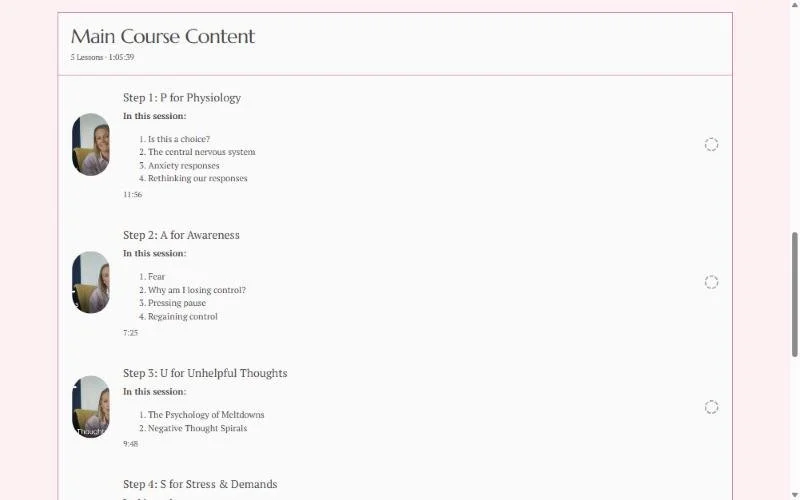
Your 5 short coaching sessions
About an hour and a half in total. Watch, or listen podcast style, at your own pace.
Your scripts and one‑page plan
What to say, and what to do, for when your brain goes blank.
Your reminders around the house
The PAUSE Wall Chart™ and Pocket Pack™, right there when everything you’ve learned disappears.
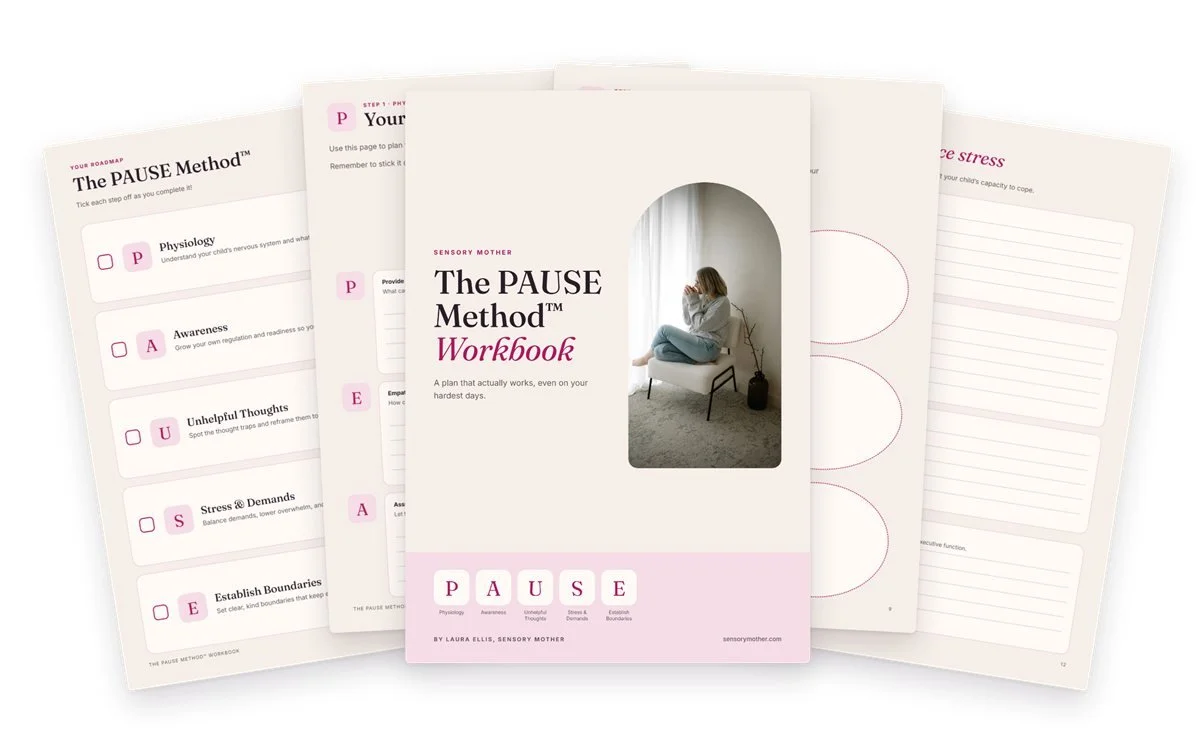
Your PAUSE™ workbook
Printable tools and plans to spot what’s pushing your child over the edge, and take the pressure off.
Making Sense of Meltdowns™
A 30-minute training on the 7 hidden triggers behind neurodivergent meltdowns, with its own workbook and trackers.
This is what every session feels like: simple, clear and easy to follow.
This is for you if…
- You’re the mum of a PDA, autistic or ADHD child, diagnosis or not, and meltdowns are running your home.
- You’ve tried firmer boundaries, letting things go, the charts and the consequences, and nothing sticks.
- You love to learn, and you’re ready to put it into practice.
- You’re ready to change the one thing you can control: how you respond.
- You want something you can start tonight, not another waiting list.
It may not be for you if…
- You’re waiting for your child to change first.
- You’re hoping that learning more will be enough on its own.
In their words
★★★★★It’s helped me make lasting change for my family. I don’t dread mornings any more!
Rebecca, mum to an 8-year-old son
★★★★★I’ve learned that by supporting him rather than reacting, I can help prevent situations (and my own response!) from escalating which has been incredibly powerful. I now feel equipped with practical, compassionate responses that I can use in the moment.
Sarah, mum to a 10-year-old son
★★★★★Laura breaks everything down into easy steps and explains things in a way that no one ever has before. Things feel so different now.
Catharine, mum to a 12-year-old daughter
I’ve been exactly where you are.
I was the behaviour management expert, a teacher specialising in SEN. But nothing worked for my son. His meltdowns became so explosive that I was signed off work and prescribed anti‑depressants. I’d read everything. In the moment, I couldn’t reach any of it.
Therapy for myself changed everything. I turned the spotlight round, away from fixing his behaviour, and onto how I was responding. I realised I didn’t need to know everything about neurodivergence. Not 974 things. Five. Those 5 things became the 5 steps of PAUSE™.
Today, I can pause. I don’t get pulled into his storm any more. Hard moments still happen, but we move through them in minutes now, not hours. And afterwards, I can think: I did a good job there.
- Mum to neurodivergent twins
- Teacher of 20+ years
- Still working in schools, specialising in SEN and supporting parents, children and staff
- Parent coach who’s helped hundreds of mums use PAUSE™ at home
Start tonight. Step 1 takes 10 minutes.
You don’t need to wait for a diagnosis, a referral or a waiting list.
A self-guided coaching programme, without the coaching price tag.
The usual price is £47. One-off payment · No subscription · Lifetime access
- 5 short recorded coaching sessions (watch or listen)
- Scripts and a one-page plan for when your brain goes blank
- The PAUSE Wall Chart™ and Pocket Pack™
- The PAUSE™ workbook
- Bonus: Making Sense of Meltdowns™
- A £29 voucher for The PAUSE Café™, if you ever want support
Still wondering?
Will PAUSE™ stop my child having meltdowns?
Nothing can promise that, and I’d be wary of anyone who does. What PAUSE™ does is help you spot what’s pushing your child towards a meltdown and take some of the pressure off, so some meltdowns can be avoided altogether. And when one does happen, you’ll know how to respond so it doesn’t escalate the way it used to.
How quickly can I start?
Straight away. Step 1 is a 10-minute session, and it gives you something to use the same day. You don’t need to finish everything before you start making changes.
I’m a busy working mum. Will this work for me?
I created it with you in mind. The sessions are short, you can watch them or listen podcast style, and you can come back to them whenever you need.
I’ve already tried therapy and a diagnosis. Why would this be different?
A diagnosis can tell you what’s going on, and therapy often focuses on your child. PAUSE™ focuses on the part you can change today: what you see, and how you respond, in the moment itself. It works alongside other support.
5 steps to stop living in constant conflict with your child, starting tonight.
£37 (usual price £47) · Lifetime access · 48-hour guarantee
P.S. Tomorrow’s 3.40pm is coming either way. Step 1 takes 10 minutes, and you could be using it tonight.
Laura x